The Dynamics of Soviet Society by W. W. Rostow & Alfred Levin
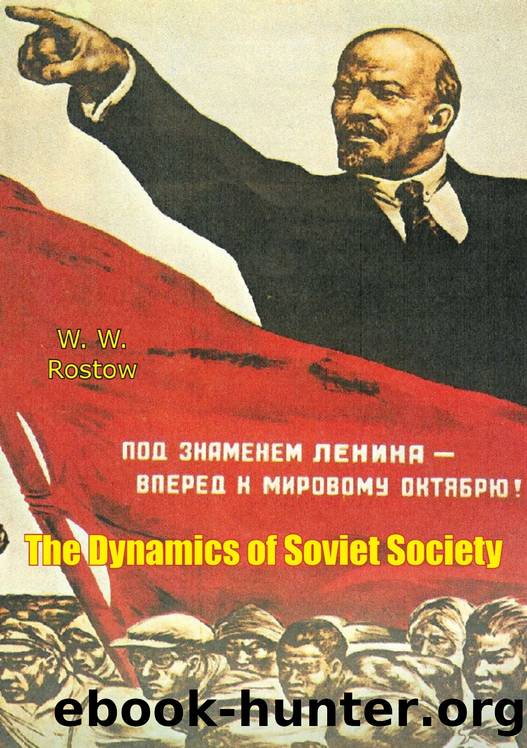
Author:W. W. Rostow & Alfred Levin [Rostow, W. W. & Levin, Alfred]
Language: eng
Format: epub
Tags: Nonfiction, Social & Cultural Studies, Political Science, Government, Communism & Socialism, History, Asian, Russia, International
ISBN: 9781839743443
Google: GpFBAAAAIAAJ
Amazon: B087JN1X1B
Barnesnoble: B087JN1X1B
Goodreads: 53677248
Publisher: Barakaldo Books
Published: 2020-04-23T00:00:00+00:00
5 The Russian Heritage and the Priority of Power
The human and physical materials of Russia have thus strongly affected the content of Soviet policy. They have helped alter almost beyond recognition the character of the regimeâs ideology. They have helped determine the concrete objectives, internal and external, which the regime has sought in its efforts to consolidate and enlarge its power.
There is, moreover, a significant interweaving of Russian elements with the patterns of Marxist thought. Three major points of convergence between Marxism and the Russian heritage can, in particular, be noted.
First, the concept of conflict between the socialist state and its capitalist environment links well to the history of Russiaâs awkward relations to the Western world, with its differing religious and cultural foundations, periodic conflicts and invasions. It is notable that, while both Marxist and national elements are invoked in Soviet propaganda (for example, by Beria in his speech of November 7, 1951), the weight of emphasis falls increasingly on the danger of a recurrence of a historical menace to Russia rather than on the capitalist encirclement of a socialist state.
Second, the pattern of Russian history as well as the concepts of Marxism would suggest restraint by the Soviet state in launching an external military campaign with Russian troops. Russia has been only cautiously aggressive outside its own borders in the past. Its major military excursions have been as riposte to invasion.
Third, this traditional caution may link with another fact of Russian history; namely, that Russia now stands at an intermediate state of transition to industrialization, with its period of maximum relative economic strength still some decades off. To the extent that an element of Marxist faith prevails within the regime, these national characteristics might support a Marxist historical perspective on a future in which ultimate Communist victory is, if not guaranteed, regarded with sufficient confidence to make it advisable to avoid the risks of defeat in major war at the present intermediate historical stage.
Despite the complex infiltration of the present regime with elements of substance and behavior derived from a long Russian past, it is the burden of the present argument, taken as a whole, that the motivation of the leadership, and the institutional arrangements into which they have now crystallized, are not to be understood in terms of the interests of the Russian peoples or the Russian nation, but in terms of the continuity and enlargement of the regimeâs own power, narrowly defined. Only to the extent that the enlargement of Russiaâs strength and power was required for this prior goal has the regime pursued Russian endsâalthough it has increasingly sought to identify its policy, in the minds of the people, with the Russian national interest and with the national heritage. The distinction appears important for an understanding of the Soviet pastâand it may be decisive to the Russian future.
The nature of the distinction stems from the whole dynamic process by which the Bolsheviks gained and then consolidated and enlarged their power. It stems, in fact, from Leninâs adaptation of the Marxist ideology.
Download
This site does not store any files on its server. We only index and link to content provided by other sites. Please contact the content providers to delete copyright contents if any and email us, we'll remove relevant links or contents immediately.
| Arms Control | Diplomacy |
| Security | Trades & Tariffs |
| Treaties | African |
| Asian | Australian & Oceanian |
| Canadian | Caribbean & Latin American |
| European | Middle Eastern |
| Russian & Former Soviet Union |
The Secret History by Donna Tartt(19085)
The Social Justice Warrior Handbook by Lisa De Pasquale(12190)
Thirteen Reasons Why by Jay Asher(8909)
This Is How You Lose Her by Junot Diaz(6885)
Weapons of Math Destruction by Cathy O'Neil(6279)
Zero to One by Peter Thiel(5801)
Beartown by Fredrik Backman(5751)
The Myth of the Strong Leader by Archie Brown(5507)
The Fire Next Time by James Baldwin(5442)
How Democracies Die by Steven Levitsky & Daniel Ziblatt(5218)
Promise Me, Dad by Joe Biden(5153)
Stone's Rules by Roger Stone(5087)
A Higher Loyalty: Truth, Lies, and Leadership by James Comey(4960)
100 Deadly Skills by Clint Emerson(4924)
Rise and Kill First by Ronen Bergman(4788)
Secrecy World by Jake Bernstein(4752)
The David Icke Guide to the Global Conspiracy (and how to end it) by David Icke(4717)
The Farm by Tom Rob Smith(4507)
The Doomsday Machine by Daniel Ellsberg(4490)
